Scrubber
Scrubbers are the perfect solution to reduce the polluting emissions released into the atmosphere, thus helping to improve the quality of the air we breathe. We build wet abatement towers from 1,400 to 55,000 m³/h, in vertical packed, floating bed or horizontal configuration for installations with limited height, sized on the chemistry of the process: acid vapours, ammonia and nitrogen oxides, with automatic reagent dosing and continuous pH control. For ammonia abatement we have a dedicated page on NH₃ scrubbers, covering sizing criteria and the two-stage and ATEX configurations.
They are designed in such a way that the liquid flow, introduced from above by means of spraying nozzles, is allowed to flow by gravity, inside the tower, on a static bed of Pall Rings, while the gas is introduced countercurrent to the descending liquid flow.
Thanks to the Pall Rings, the contact surface between the liquid solution and the process gases is increased, generating chemical reactions that allow the liquid to retain the dust or pollutants to be broken down contained in the gases.
The liquid dispenser consisting of spraying nozzles is located at the top. A droplet separator is used to prevent the entrainment of liquid particles in the atmosphere.
Finally, the liquid is collected in the tank at the base of the tower, and from here it is drawn out with special pumps and continuously recirculated through the spray nozzles.
What a scrubber abates and how to choose one
Abatement efficiency, scrubbing chemistry and materials all depend on the pollutant to be treated: below are the criteria used to assess and size a fume abatement system.
Acid and alkaline vapours: chemistry does the work
A wet scrubber does not filter: it neutralises. Acid gases typical of surface treatments — hydrochloric, hydrofluoric, nitric and sulphuric acid — are abated by circulating an alkaline solution through the tower; conversely, ammonia and amines require an acid solution. This is why the scrubbing liquid is hardly ever plain water: the reagent depends on the pollutant to be treated, and the pH of the solution must be kept within a working range for abatement to remain constant over time.
Dust, mists and droplet carry-over
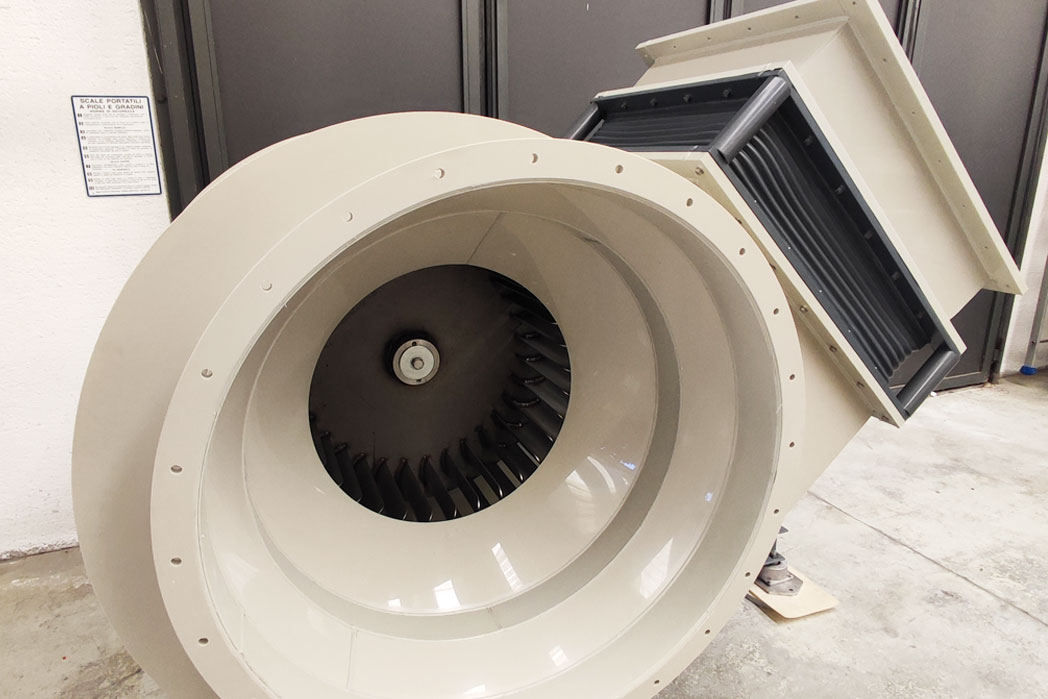
Besides soluble gases, the tower retains process dust and mists. The droplet separator installed at the top prevents the atomised liquid from being carried into the exhaust duct: without it, reagent would be lost and the fan and stack would be damaged.
Efficiency: what it really depends on
Abatement is not an absolute figure but the result of several combined factors: the solubility of the pollutant in the scrubbing liquid, the contact time between gas and liquid — hence packing bed height and gas velocity — the liquid-to-gas ratio, and the pH maintained in the tank. This is why two systems with the same airflow can perform very differently, and why sizing always starts from an analysis of the effluent to be treated.
Configurations and materials
The vertical packed tower covers most applications; the horizontal version is the answer where available height in the plant is limited. Stages can be one or two, depending on whether a single chemistry or two sequential treatments are required. Materials are selected according to the aggressiveness of the effluent and the operating temperature: rigid polypropylene and PVC are the solutions used in Syntech systems.
Horizontal scrubbers: when to choose them
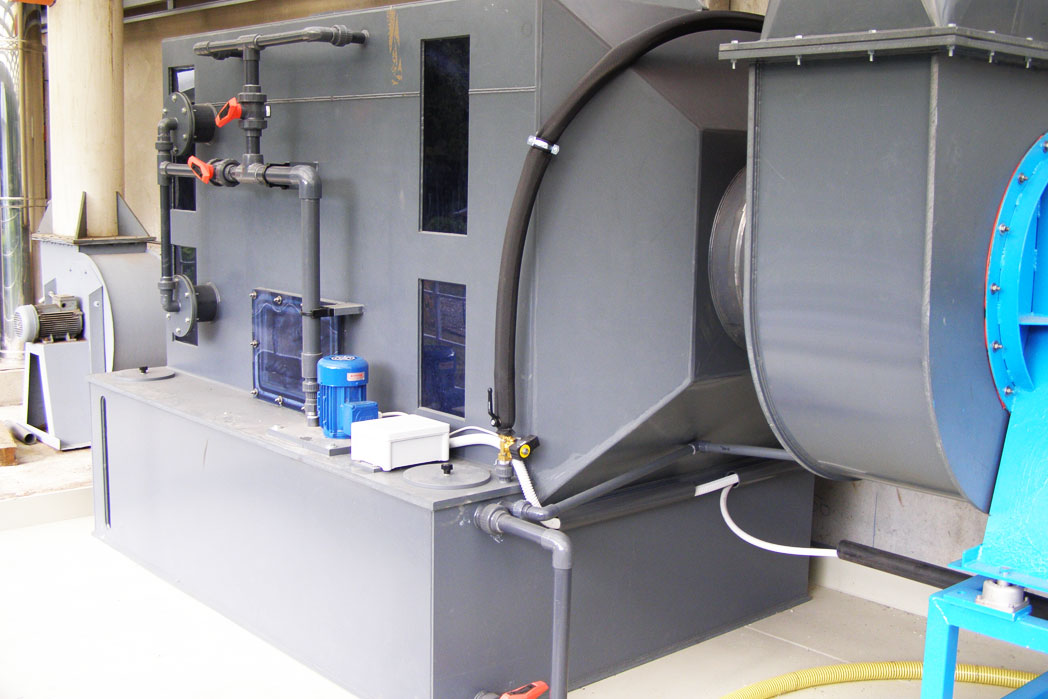
In a horizontal scrubber the air flow crosses the packing stages horizontally instead of rising through a vertical tower. This is the configuration to choose when the available height is limited: installations inside the shop floor, above a mezzanine or under a canopy, where a vertical tower would not fit. For the same treated flow rate the footprint develops in length rather than in height, and the packing stages remain accessible from ground level for maintenance.
Our horizontal scrubbers cover flow rates from 5,000 to 40,000 m³/h and are made entirely of plastic material (PVC or polypropylene), for the forced washing and neutralisation of highly corrosive gases, with an operating temperature up to 50 °C. The packing consists of Pall Rings continuously sprayed by atomising nozzles; a special-profile lamellar droplet separator is fitted in the final stage to retain liquid carry-over.
Standard equipment includes a 400 litre base tank, PVC grid and demister, washing manifolds with full-cone nozzles, a vertical centrifugal recirculation pump and a reagent dosing unit with a 50 litre PEHD tank. Automation is PLC based with a touch screen operator panel.
Floating bed scrubbers
Alongside fixed packed towers with Pall Rings we build floating bed towers, where the packing consists of hollow polypropylene spheres free to move within the gas flow. The continuous movement of the spheres limits clogging when the gas carries dust or substances that tend to foul the packing, and it is the configuration we use for the highest flow rates. Our floating bed towers reach 55,000 m³/h in a two-stage arrangement, with a polypropylene column up to Ø2,350 mm and an overall height of about 9,200 mm, PVC droplet separator and EPDM gaskets.
What we abate: acids, ammonia and nitrogen oxides
Our scrubbers treat acid vapours — typically hydrochloric acid extracted from process hoods — dosing caustic soda (NaOH); ammonia (NH₃), including fumes from biogas plants and in ATEX execution, dosing an acid neutralising solution (hydrochloric or sulphuric acid); and nitrogen oxides (NOx), with dedicated two-stage towers. In every case the reagent is not dosed on a timer: a continuous pH control is installed on the recirculation circuit, commanding the top-up of the neutralising solution and raising an alarm when the value moves outside the set threshold.
Integration with chemical delivery systems (CDS)
The scrubber can manage dosing on board or be fed by a centralised chemical delivery system: in that case the tower sends a product request to the box and raises an alarm if the solution runs out. This is the configuration we use when several scrubbers operate in the same plant, with separate boxes for acid and alkaline reagents, leak detector, containment basin and PLC management with an operator panel. See our chemical dosing systems (CDS).
More than the tower: the complete extraction line
We supply the whole extraction and abatement line: fans, polypropylene piping and bends, ventilation dampers, settling tanks and containment basins, stacks up to Ø1,600 mm and 12 metres high complete with sampling ports for emission measurement, and electrical panels with PLC and supervision.
Where our scrubbers are installed
Our abatement plants are in operation at industrial sites in Italy and in several European and non-European countries, in sectors ranging from semiconductors to industrial waste treatment and biogas plants.
Operation and maintenance
An abatement system performs well when it is looked after: periodic checks of pH and tank level, blowdown and make-up of the solution, inspection of the spray nozzles, cleaning of the packing bed and of the droplet separator, routine maintenance of the fan. Simple operations, but they determine real efficiency over time.
Regulatory context
In Italy, conveyed emissions into the atmosphere are governed by Part Five of Legislative Decree 152/2006: Article 269 covers ordinary authorisation, while Article 272(2) provides a simplified procedure for activities with low emission impact. The limit values to be met are set by the authorisation issued by the competent authority, so system sizing always starts from those values and from the actual characteristics of the effluent.
What is needed for an assessment
Sizing a scrubber correctly requires a few essential data: the airflow to be treated in m³/h, the type and concentration of the pollutants present, the temperature of the effluent, the emission limits to be met, the available space and any height or layout constraints.
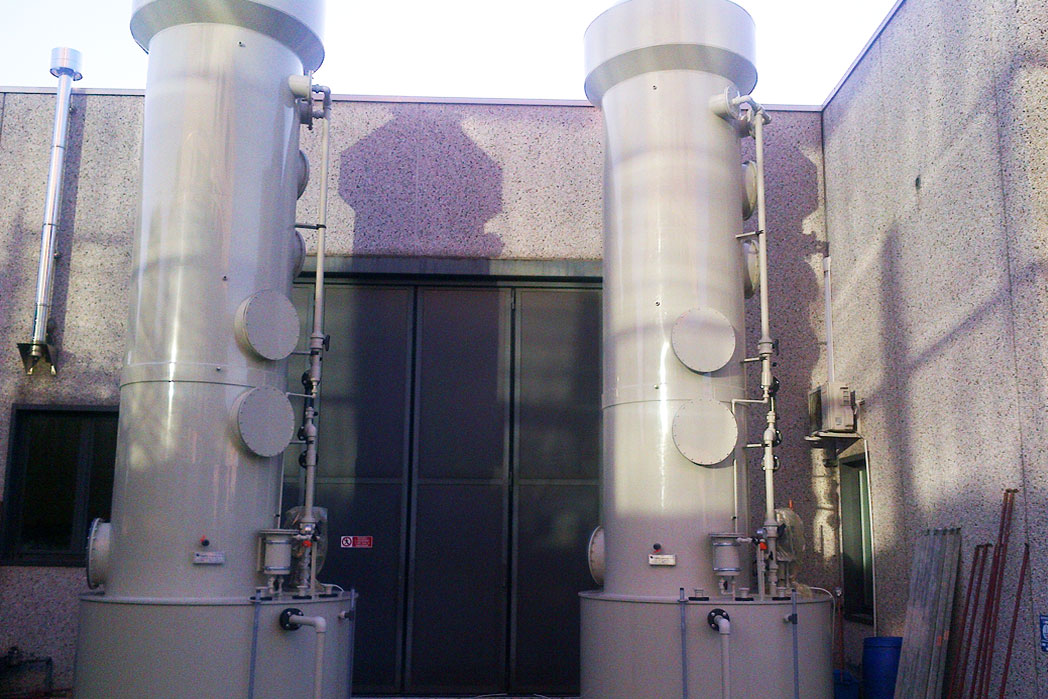
Fume abatement tower with a flow rate of up to 20000 m3/h. Made entirely of rigid polypropylene, operating temperature 1 ÷ 50 °C. Equipped with spraying nozzles, 2 abatement stages and recirculation pumps. Pall Rings packing and lamellar droplet separator; horizontal layout suited to installations with limited available height.
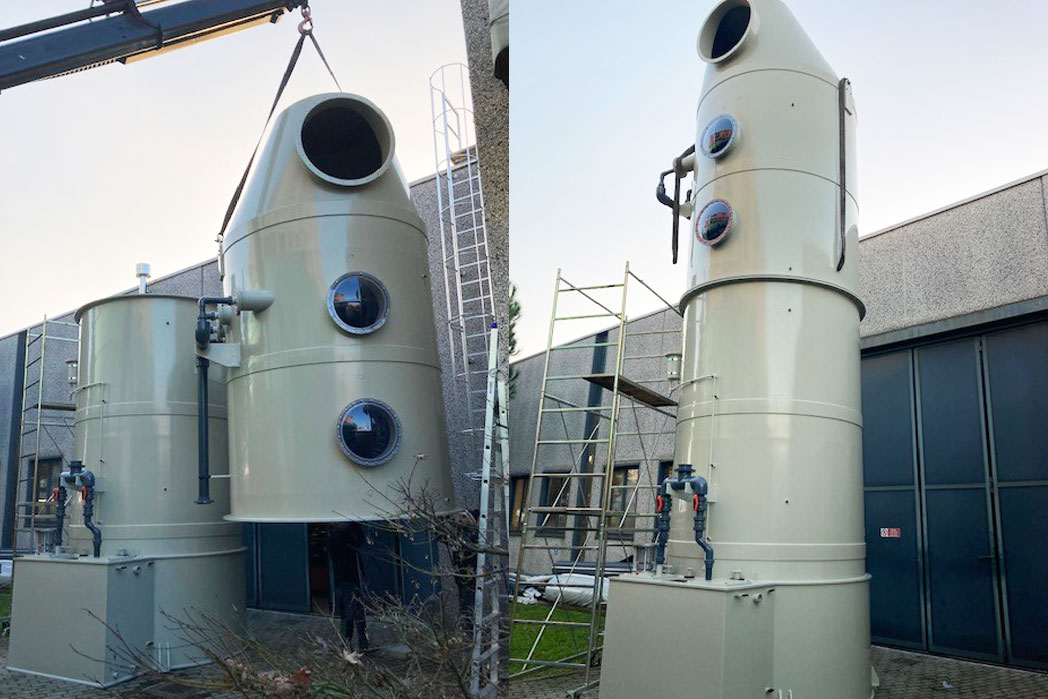
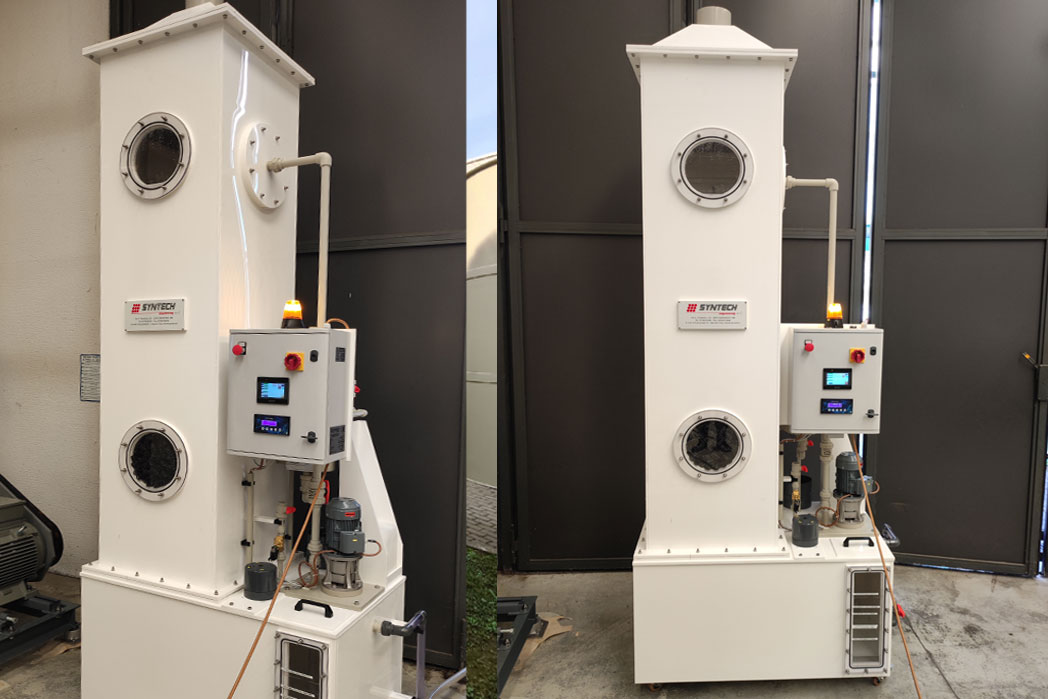
Automated fume abatement tower with a flow rate of 1400 m3/h. Made entirely of rigid polypropylene, operating temperature 1 ÷ 50 °C. Equipped with spraying nozzles, 1 abatement stage and recirculation pump. It is possible to see and change the process parameters through the integrated HMI.